Indice - Table of contents
Beyond Salsa Piano - The Cuban Timba Pian... 

- Beyond Salsa Piano Info Page
- Audio and Video Files
- Beyond Salsa Piano - Vol. 1 - 1900-51 - I...
- Beyond Salsa Piano - Vol. 1 Examples
- Beyond Salsa Piano - Vol. 2 - 1940-59 - I...
- Beyond Salsa Piano - Vol. 2 Examples
- Beyond Salsa Piano - Vol. 3 - Int. - 1960...
- Beyond Salsa Piano - Vol. 3 Examples
- Beyond Salsa Piano - Vol. 4 - Int. - 1979...
- Beyond Salsa Piano - Vol. 4 Examples
- Beyond Salsa Piano - Vol. 5 - Advanced - ...
- Beyond Salsa Piano - Vol. 5 Examples
- Beyond Salsa Piano - Vol. 6 - Melón Lewi...
- Volumes 7 and Beyond
- Purchasing Beyond Salsa Piano
Lo Nuevo[hide]
Resenas: Habana a Todo Blues
Reportes: From The St... : Cubadisco 2...
Reportes: From The St... : Cubadisco 2...
Resenas: Falcón in Blue
Resenas: Figure It Out
Reportes: From The St... : Jazz Plaza ...
Tienda: Cuban Music Store
Reportes: From The St... : Cubadisco 2...
Fotos: Tom Ehrlich
Musicos: Juan Formell
Musicos: Yordamis Megret Planes
Musicos: Yasser Morejón Pino
Musicos: José Luis "Changuito" Quintana...
Musicos: Dennis Nicles Cobas

Fotos Del Día [hide]




Kevin Moore - Beyond Salsa Piano - Vol. 1 Examples
Examples from Beyond Salsa Piano, Volume1
Chapter 1 discusses the concept of the tumbao -- explaining what it is and following its development from its African origins through the various Cuban genres of the 20th Century to its integral role in rock, soul, jazz and funk.
Chapter 2 covers changüí, the first genre to use tumbaos on instruments other than pitched drums. Changüí tumbaos, or guajeos, are played on the tres, making them ideal material for beginning pianists.
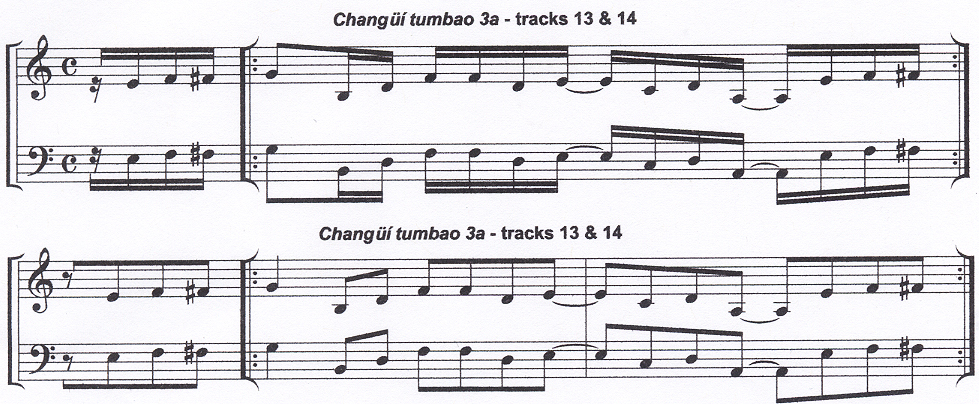
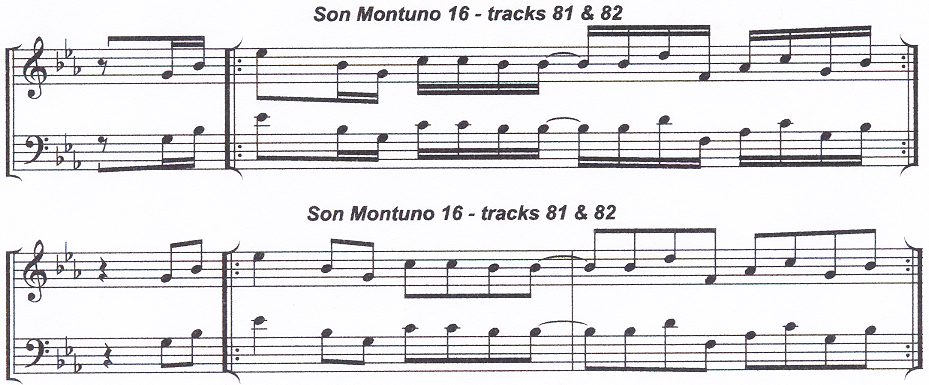
Each tumbao is shown in 16th note and 8th note notation, with two audio files, one at full speed and one in slow motion. The left and right hand parts are panned hard left and right respectively so you can use the balance control to learn each hand separately by ear if you don't read music. Even if you do read music, we suggest learning them by ear if you have the patience, and only using the music to check your results. If you learn it by ear, you "own it".
Later in Chapter 2, we cover kiribá and nengón, two very easy genres which pre-date changüí.
Chapter 3 discusses rumba, which, although it doesn't use tumbaos, is essential to mastering the feel of Cuban music.
Chapter 4 contains several tumbaos derived from danzón violin parts from the 1920s and Chapter 5 deals with very easy son tres guajeos from the 1920s and 1930s.
Chapter 6 on son montuno, is the longest section of Volume 1. It can be thought of as a pianist's companion to my online book on the bass tumbaos of Arsenio Rodríguez between 1940 and 1951.
Volume 1 also contains an extensive appendix on clave and rhythmic terminology.