


Indice - Table of contents
Beyond Salsa Piano - The Cuban Timba Pian... 

- Beyond Salsa Piano Info Page
- Audio and Video Files
- Beyond Salsa Piano - Vol. 1 - 1900-51 - I...
- Beyond Salsa Piano - Vol. 1 Examples
- Beyond Salsa Piano - Vol. 2 - 1940-59 - I...
- Beyond Salsa Piano - Vol. 2 Examples
- Beyond Salsa Piano - Vol. 3 - Int. - 1960...
- Beyond Salsa Piano - Vol. 3 Examples
- Beyond Salsa Piano - Vol. 4 - Int. - 1979...
- Beyond Salsa Piano - Vol. 4 Examples
- Beyond Salsa Piano - Vol. 5 - Advanced - ...
- Beyond Salsa Piano - Vol. 5 Examples
- Beyond Salsa Piano - Vol. 6 - Melón Lewi...
- Volumes 7 and Beyond
- Purchasing Beyond Salsa Piano
Lo Nuevo[hide]
Reportes: From The St... : Cubadisco 2...
Reportes: From The St... : Cubadisco 2...
Resenas: Falcón in Blue
Resenas: Figure It Out
Reportes: From The St... : Jazz Plaza ...
Tienda: Cuban Music Store
Reportes: From The St... : Cubadisco 2...
Fotos: Tom Ehrlich
Staff: Kristina Lim
Musicos: Juan Formell
Musicos: Yordamis Megret Planes
Musicos: Yasser Morejón Pino
Musicos: José Luis "Changuito" Quintana...
Musicos: Dennis Nicles Cobas

Fotos Del Día [hide]




Kevin Moore - Beyond Salsa Piano - Vol. 1 - 1900-51 - Introduction
Click here for the new Beyond Salsa Online Catalog
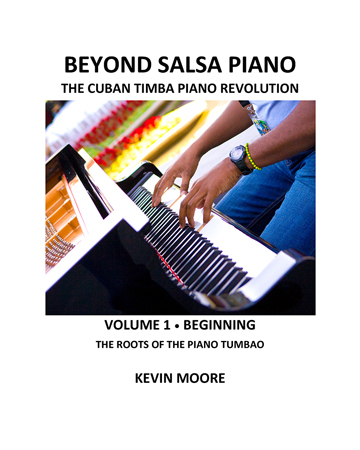
Volume 1 has dual purposes: to chronicle the earliest ancestors of the piano tumbao and to provide exercises for beginning pianists to develop the technique necessary to play salsa and timba piano tumbaos. It begins with piano adaptions of tres guajeos from the seminal folkloric genre of changüí, which predates the first Cuban recordings. Next we study the danzón and son genres of the 1900-1940 period to look for early roots of the modern piano tumbao in the tres and violin parts. The volume concludes with an extensive study of the various types of tumbaos pioneered by Arsenio Rodríguez in the 1940s.
This material is ideal for a “beginning” method book for two reasons:
- Because the patterns were original played on stringed instruments, they can be learned very easily by a beginning pianist.
- The material is also the beginning historically – the first instances of tumbaos in pop music.
Depending on your style of learning, you may want to start by reading the explanatory text to absorb “the big picture”, or you may want to dive right in and learn the music, after which the explanations will have much more meaning. You may want to learn the patterns by reading the music or by ear.
The material in Volume 1 is arranged chronologically:
- Changüí (originated prior to 1900)
- Danzón (1900-1940)
- Son (1915-1940)
- Son Montuno (1940-1951)
If you already have some experience playing piano, we suggest tackling the material in this order, but if you have limited technique, we suggest that you learn the exercises in order of difficulty:
- Son
- Danzón
- Son Montuno
- Changüí